
First Aid for Gunshot Wounds: Why Everyone Who Carries Should Learn It
If you carry a firearm, spend time at the range, or hunt, you have already accepted responsibility for a tool that can cause serious injury. The next logical question is one most gun owners never ask: if someone is bleeding badly, would you know what to do in the first few minutes? That is exactly the gap that first aid for gunshot wounds is designed to close.
You are the first responder, whether you planned to be or not
When a serious injury happens, professional help is almost never standing next to you. Even with a fast 911 response, several minutes can pass before paramedics reach the scene, make it safe to approach, and begin treatment. Severe bleeding does not wait. A person can lose a dangerous amount of blood in a very short time, which means the people already on scene — you, a range partner, a family member — are the ones who matter most in those opening minutes.
This is not about playing doctor. It is about recognizing a simple reality: the outcome of a serious bleeding emergency is often decided before EMS ever arrives. Learning basic bleeding-control skills is one of the most responsible things anyone who is regularly around firearms can do, and it complements the safety habits you already practice every time you handle a gun.
What first aid for gunshot wounds actually covers
People sometimes imagine trauma care as something complicated and clinical. The foundational skills taught to everyday citizens are far more approachable than that. Good introductory training focuses on a small set of high-impact fundamentals you can realistically remember under stress:
- Scene safety first. Before you help anyone, you learn to make sure the threat is over and the environment is safe enough to act. You cannot help if you become the next casualty.
- Recognizing life-threatening bleeding. Not every wound is an emergency, and not every emergency looks dramatic. Training helps you quickly tell the difference so you focus on what will actually save a life.
- Direct pressure. The simplest, most universal tool. Firm, sustained pressure on a bleeding wound is often the single most effective thing a bystander can do.
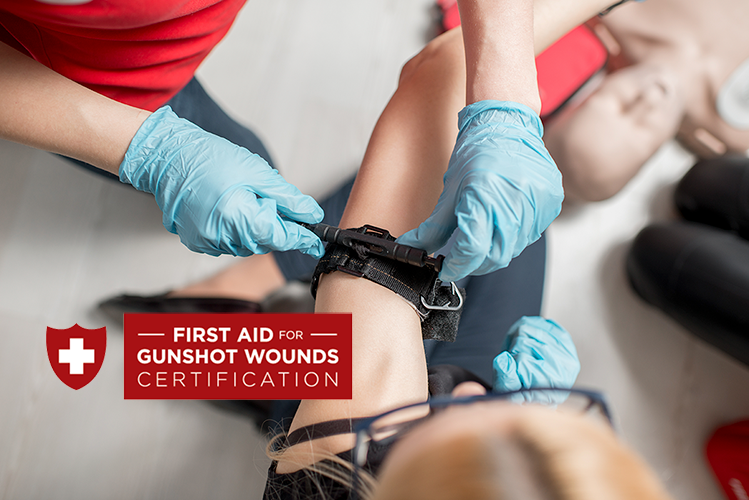
- Tourniquet use. For severe bleeding on an arm or leg, a proper tourniquet applied correctly can control blood loss. Training covers when it is appropriate, how to place it, and why hesitation is the real danger.
- Wound packing and pressure dressings. For wounds where a tourniquet cannot be used, you learn the general principles of packing and applying pressure to slow bleeding.
- Getting help fast. Activating 911, communicating clearly, and handing off to professionals is part of the plan, not an afterthought.
The goal is confidence with a few reliable actions, not a medical degree. When something goes wrong, you want muscle memory and a calm plan — not a blank stare.
Who should learn these skills
Trauma and bleeding-control basics are valuable for a much wider audience than most people assume. Consider taking training seriously if you are:
- A concealed carrier or anyone pursuing a License to Carry in Texas.
- A recreational or competitive shooter who spends time at ranges.
- A hunter, often far from immediate medical help.
- A parent or household member in a home with firearms.
- A working or aspiring security professional. If you are training to become a licensed officer through our Texas security officer path, bleeding-control knowledge is a genuine professional asset.
Honestly, these skills are not even gun-specific. Serious bleeding happens in car crashes, workplace accidents, kitchen and power-tool mishaps, and more. Learning them makes you more useful in a wide range of everyday emergencies — not just ones involving firearms.
What this training is — and is not
Let us be clear and responsible about scope. An introductory course in first aid for gunshot wounds is educational and awareness-focused. It is not a substitute for professional emergency medical care, a paramedic certification, or a physician’s judgment. The point of learning is to help you take sensible, potentially lifesaving action in the gap before professionals arrive, and then to get the injured person into the hands of EMS as quickly as possible. Always call 911 and follow the guidance of medical professionals and the manufacturer instructions for any equipment you use. Skills also fade without practice, so periodic refreshers matter.
How Nighthawk Alliance approaches it
We are a veteran-owned, Texas DPS-licensed training academy in Fort Worth, and safety-first thinking runs through everything we teach. Our First Aid for Gunshot Wounds online course is built for everyday people who want a clear, no-nonsense introduction to bleeding-control fundamentals — no medical background required, and available online so you can start on your own schedule.
For many gun owners, the strongest approach is to pair medical awareness with sound shooting fundamentals. If you want individualized, hands-on coaching on safe firearm handling alongside your trauma education, our private firearms lessons in the DFW area give you focused, one-on-one instruction. Competence with the firearm and competence in an emergency are two sides of the same responsibility.
Frequently asked questions
Do I need a medical background to take a first aid for gunshot wounds course?
No. Introductory bleeding-control training is designed for everyday people with no medical experience. The focus is on a small set of clear, practical fundamentals anyone can learn. It is educational and does not replace professional medical care or certification.
Is the course available online?
Yes. Our First Aid for Gunshot Wounds training is offered online, so you can begin learning the basics on your own schedule from wherever you are.
How long does it take?
Because it is an online, self-paced introduction, you can typically work through the core material in a single sitting or across a few shorter sessions. The bigger value comes from revisiting the fundamentals periodically so the actions stay fresh if you ever need them.
Will this replace calling 911?
Never. These skills are meant to help you act in the critical minutes before professionals arrive. Always call 911 immediately in an emergency and hand off to EMS as soon as they are on scene.
Carrying responsibly means being ready to help, not just to defend. Start building that readiness with our First Aid for Gunshot Wounds online course, and contact our Fort Worth team if you want to combine it with hands-on firearms coaching.